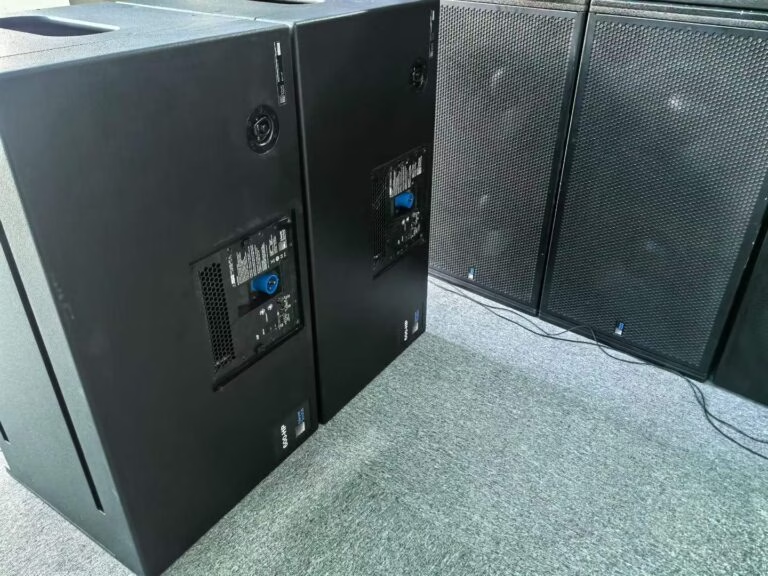
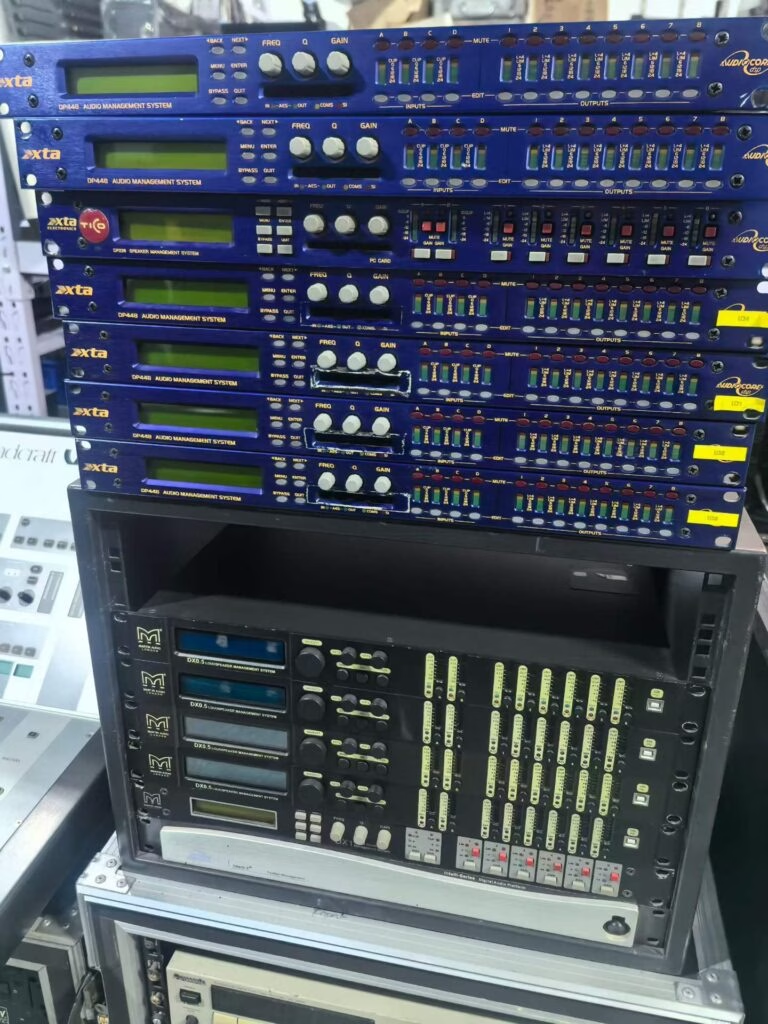
Yes. Adding subwoofers under full-range tops without a crossover just doubles the energy between roughly 60 and 120 Hz. You get a boomy, unclear low end and lose headroom on both amps. The fix is a crossover or a DSP with high-pass and low-pass filters, and it costs $60 to $150 used.
What actually happens without a crossover?
Your 12-inch top is still trying to produce 70 Hz. Your sub is also producing 70 Hz. They arrive out of phase depending on distance, so at some seats the low end is doubled and at others it cancels. That is why an uncrossed system sounds huge at FOH and thin at the bar.
Second problem: power. Sending 70 Hz to a top box wastes maybe 30 percent of its amplifier on frequencies it cannot reproduce. If your top is a self-powered box with a limiter, that wasted power is stealing headroom from the midrange.
Where should the crossover point sit?
For a 12-inch top over an 18-inch sub, 90 to 110 Hz is the normal window. If the top goes down to 60 Hz comfortably, try 80 Hz. If the top is a small 10-inch box that struggles below 100 Hz, cross at 110 to 120 Hz instead.
| Top box | Sub size | Starting crossover |
|---|---|---|
| 10-inch, 2-way | 15-inch | 110-120 Hz |
| 12-inch, 2-way | 18-inch | 90-100 Hz |
| 15-inch, 2-way | 2×18-inch | 80-90 Hz |
| Line array element | 18-inch array sub | Factory preset only |
Analog crossover or DSP?
Analog if you want to set it and forget it. A used 2-way or 3-way analog crossover is $60 to $150, has no menu, and works in the rain. DSP if you want delay alignment, limiting, and EQ, which is what you actually need for subs placed under a stage lip.
A used digital console with matrix outputs, like the Yamaha DM1000, can do the crossover in the console using output processing, feeding tops and subs from separate matrix paths. That saves a rack unit and a power cable, though it means the console must stay on for the system to work.
What about phase and delay?
If the subs sit 1 metre in front of the tops, you need about 3 ms of delay on the subs to align them, because sound travels roughly 343 m/s. Get that wrong and the crossover region loses 6 dB or more at the crossover point. Every DSP has a delay function; no analog crossover does. This is the main argument for DSP.
A quick sanity test
Play a 100 Hz sine, walk the room, and listen for a spot where it disappears. If the low end drops out in the middle of the dance floor, your crossover or delay is wrong, not your sub. Ten minutes with a phone SPL app will tell you more than a spec sheet.
Key Takeaways
- Always use a crossover when adding subs to full-range tops.
- Without one, 60-120 Hz is doubled and phase cancellation makes the room uneven.
- Start at 90-110 Hz for a 12-inch top over an 18-inch sub.
- DSP wins when you need delay alignment; analog is cheaper and simpler.
- A 100 Hz sine walk test finds crossover problems in ten minutes.