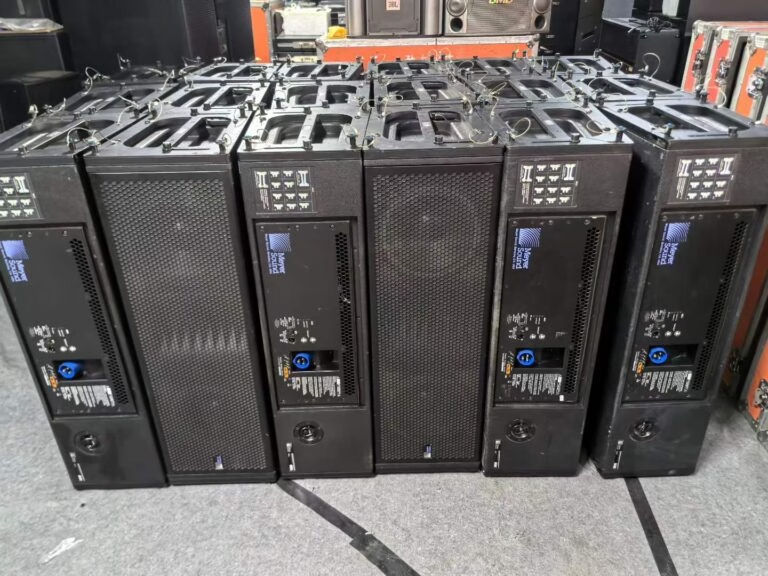
Yes — used powered PA speakers are usually worth it. A working active cabinet from a pro brand costs 40-60% less than the new price and still has most of its usable life left. The K-array KF12, for example, is a self-powered 2-way box with 12 units sitting in stock right now. The real question is not „used or new“, it is „which used cabinet, from whom, and at what price“.
What does „powered“ actually change for a used buyer?
A powered (active) speaker has the amplifier built into the cabinet. That is one cable instead of two, and no separate amp rack. For a used buyer the trade-off is simple: fewer parts to match, but if the amp module dies you are replacing a whole board, not a cheap external amp. Class-D modules in modern boxes run cool and last a long time, yet a flooded or cooked cabinet is a hard fix.
Passive boxes are cheaper up front and simpler to repair. Active boxes sound more consistent because the maker already tuned the amp to the driver. If you tour and rent gear, active wins. If you keep a permanent install and have an amp rack, passive can still make sense.
How much should you pay for a used powered PA speaker?
Rough ranges in 2026. A mid-tier 12-inch powered box from a known brand usually sells used at $350-$700 per unit. Premium and touring-grade cabinets run $900-$2,500 each. If a seller asks 80% of retail, walk away — that is not a used price, that is a lazy price.
- Budget active 12″: $350-$700 used
- Pro 12″ (K-series, RCF, QSC class): $700-$1,600 used
- Touring line-array element: $1,500-$4,000+ used
- Rule of thumb: 40-60% of the new street price for „excellent“ condition
What should you check on a used active speaker before paying?
Test it loud, not at whisper level. A damaged driver often only rattles or distorts above half power. Play a full-range track and a sine sweep if you can, and listen for buzz on the low end and harshness on the top.
- Power it on cold and listen for amp hiss or protection clicks
- Push it to performance level — distortion shows up there, not at low volume
- Inspect the cone and surround for tears, water stains, or a re-cone job
- Check the back panel, XLR/TRS sockets, and fan for dust and corrosion
- Ask about the flight case — a good case means the box was actually protected
Which brands hold value, and which ones you should avoid?
Names matter for resale and repair. RCF, QSC, K-array, JBL, and Meyer Sound keep parts and service info around for years. No-name Chinese boxes sell cheap and die cheap, and you cannot get a module or a schematic. For a used buyer, a boring familiar brand is worth more than a mystery bargain.
Where do good used cabinets actually come from?
Churches, small venues, rental houses, and tours that bought new rigs. China has a large second-hand pro-audio export market because so much gear gets retired from production, install and touring in bulk. That is also where the pricing edge comes from. You can browse our current stock of professionally graded speakers, including the K-array KF12 self-powered 2-way speaker, which is a good reference point for what a clean 12″ active cab looks like.
Key Takeaways
- Used powered PA speakers are worth it at 40-60% of new price.
- Test loud: damaged drivers hide at low volume.
- Known brands (RCF, QSC, K-array, JBL, Meyer) are worth more because parts still exist.
- Avoid a dead amp module unless you can source the exact replacement board.
- Always ask what the cabinet did in its former life — install vs touring changes wear.