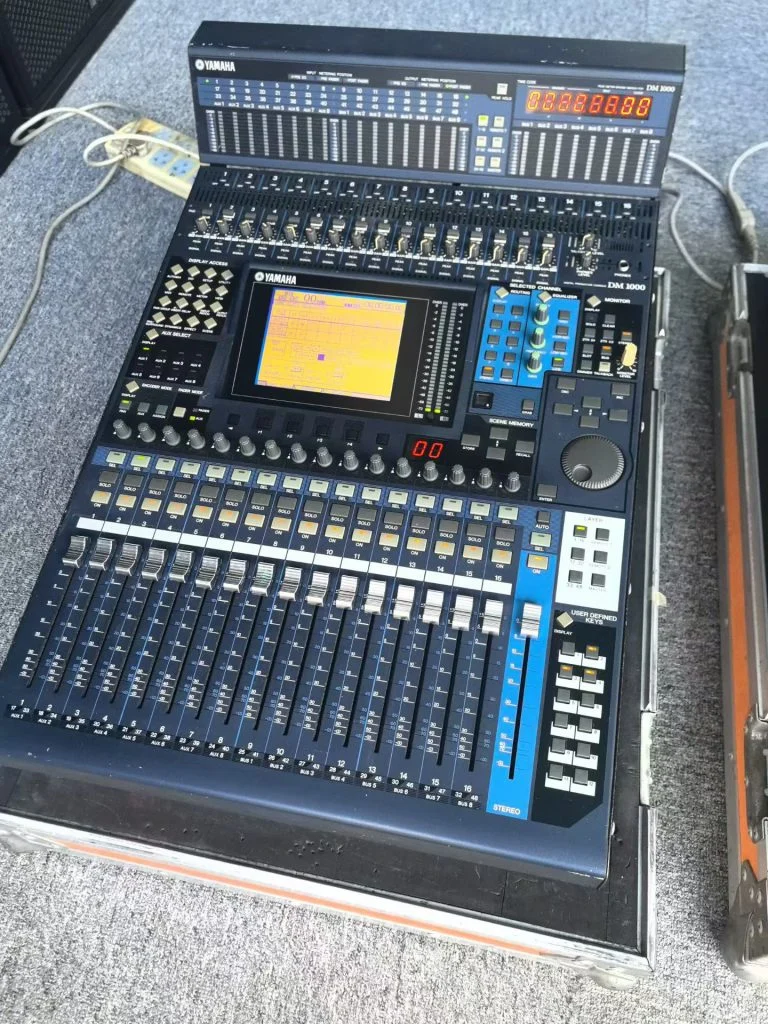
Yes, with one condition: you must actually need what it offers. The Yamaha DM1000 is a 48-channel digital console running at 96 kHz with 16 mic/line inputs and 16 motorized faders. In 2026 it still does the core job — mix, recall, route — for a small fraction of a new digital desk. What it does not have is modern stage-box networking or a big touchscreen, and that is the only reason to hesitate.
What do you actually get in a used DM1000?
A compact, road-tested digital console with onboard EQ, dynamics and effects on every channel, scene memory, and motorized faders that move to your saved settings. It handles monitor duty, a house mix, or a broadcast feed without an outboard rack. For the money, few used desks match its channel count and reliability.
Where does the DM1000 still make sense in 2026?
- Small to mid venues that want recall without a new-desk budget
- Houses of worship mixing the same service every week
- Monitor world on a mid-size tour, glued to the main desk
- Studio or rehearsal rooms needing clean digital routing and EQ
What are its real limitations?
Be honest about the trade-offs. The menu system is deep and takes getting used to. It is not a modern Dante or AVB world — its networking is old-school. A failing screen or fader board is the main repair risk, so test those hard before buying. If your workflow depends on a large touchscreen and networked stage boxes, this is the wrong desk.
What should you pay for one used?
| Condition | Realistic price |
|---|---|
| Excellent, with flight case | Top of the used range |
| Excellent, console only | Mid range |
| Good, some cosmetic wear | Lower third |
| As-is / screen fault | Only if you can source the part |
Because the model is well known and supported, prices stay stable — it does not depreciate like a two-year-old digital desk from a brand that changes its lineup every season. You can see the current DM1000 unit in our stock, which ships with its flight case and full spec.
How should you test a used DM1000 before buying?
- Run every fader up and down — listen for a slow or stuck motor
- Save and recall a scene, then confirm all settings return correctly
- Check the display for dead pixels or flicker
- Test all 16 mic/line inputs, not just a few
- Confirm the power supply and internal battery health if accessible
Key Takeaways
- The Yamaha DM1000 is still worth buying in 2026 for 48-channel digital mixing on a budget.
- You get 96 kHz operation, onboard EQ/dynamics, and 16 motorized faders.
- The main limits are old-school networking and a deep menu system.
- A failing screen or fader board is the key repair risk — test it.
- Supported classics like this hold value better than fast-depreciating modern desks.