Short answer: yes, for most buyers. A used powered PA speaker sells at 40-60% of new price, removes the amp rack from your signal chain, and fails in predictable ways you can spot with a handheld tester. The catch is chassis damage and older Class AB models that run hot.
What makes a powered speaker different from passive?
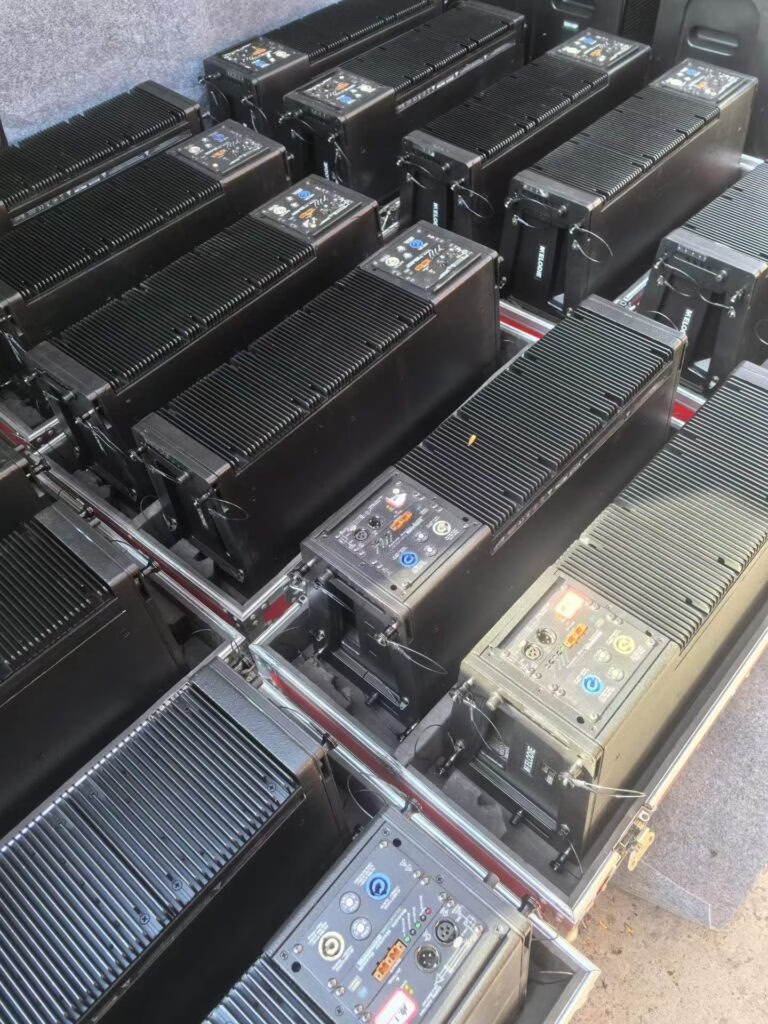
A powered box has the amplifier bolted to the back panel. One power cable and one signal cable per speaker, instead of speaker cable plus an amp rack. For a band running four boxes, that removes roughly 60 metres of cable and a 25 kg amp rack from the load-in. Fewer connections also means fewer places for hum to creep in.
The trade-off: when the amp dies, the whole cabinet is down, and replacement modules for discontinued models are hard to find. That single fact drives most of the decision.
How much do you actually save?
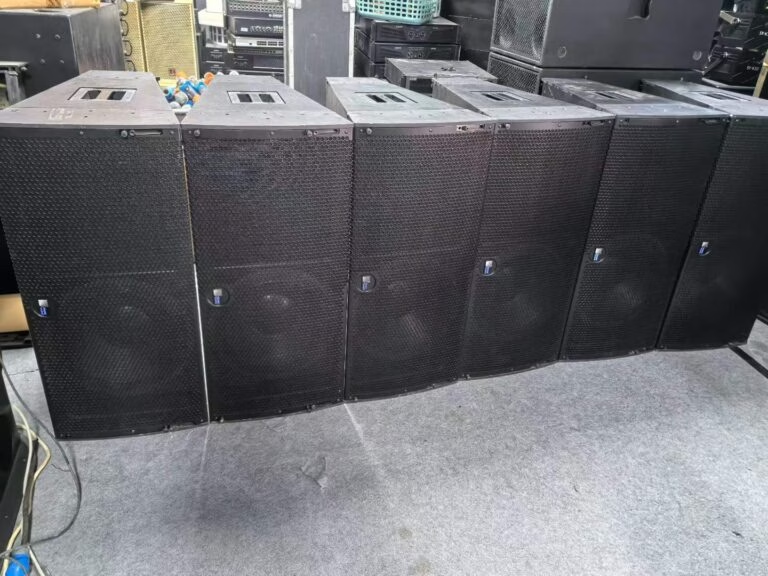
Working numbers from export stock. All figures are for fully tested units with the original grille.
| Cabinet | New price | Used price | Saving | Example |
|---|---|---|---|---|
| Powered 12-inch 2-way | $900-$1,400 | $380-$650 | 55% | K-array KF12 |
| Powered 15-inch 2-way | $1,100-$1,800 | $500-$820 | 52% | QSC K12.2 |
| Powered 18-inch sub | $1,400-$2,200 | $650-$1,100 | 50% | RCF SUB 8004 |
| Powered 10-inch 2-way | $700-$1,000 | $280-$450 | 60% | JBL EON610 |
Those savings are not free money. Budget 8-12% of the used price for a replacement amp module if the model is more than ten years old and the module is still obtainable. If it is not obtainable, treat the cabinet as disposable and price it accordingly.
Which models age well?
Class D designs with an external heatsink and a separate power supply board survive better than early Class AB units stuffed into the same box as the driver. Heat is the killer. A speaker that has run 200 nights in a hot club with no grille foam has probably had its capacitors cooked. One that sat in a rehearsal room for three years is a different animal.
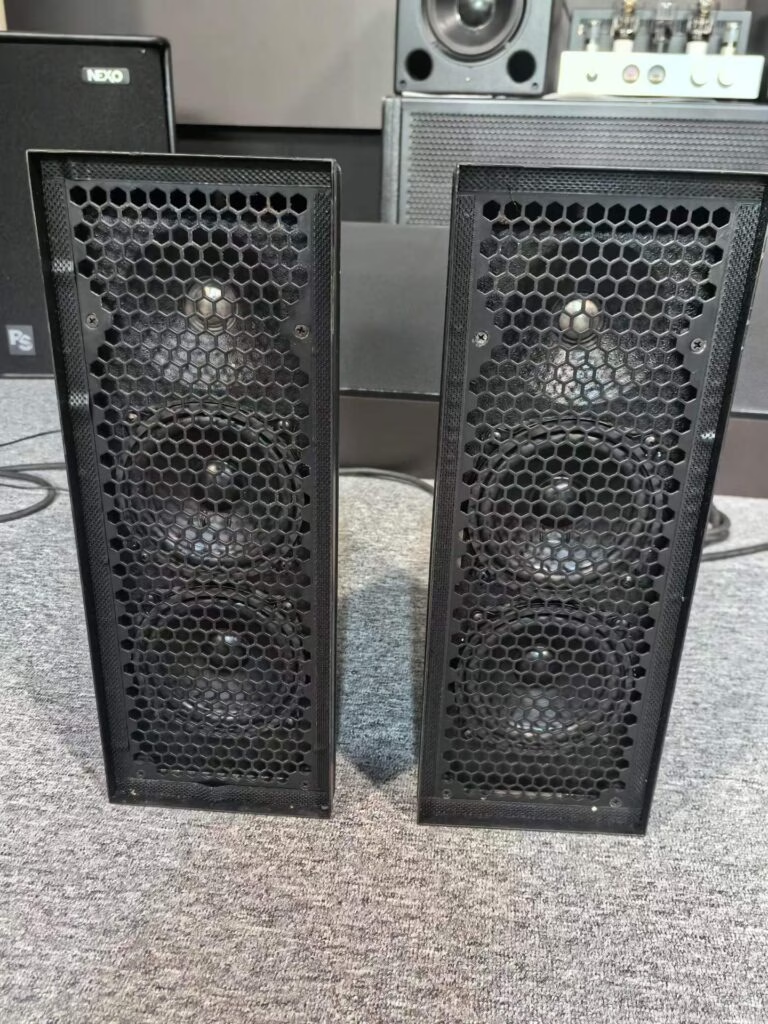
You can check the exact unit and photos on the used KF12 listing page before you commit.
I would buy a used K-array or a QSC K-series almost blind, as long as the seller sends a video of each driver sweeping. I would not touch a 2008-vintage powered box from an unknown brand with a single amp module and no thermal design, no matter how cheap.
What should you test before paying?
- Play a sine sweep from 40 Hz to 18 kHz on each cabinet and listen for rattle at the horn throat.
- Push the woofer cone gently inward and check for scraping.
- Look at the amp module screws: if they are chewed, someone has been inside.
- Run it for 20 minutes at working volume and check the back panel temperature.
- Check the cabinet edges for impact cracks, which are structural within about 15 cm of the driver.
That is about ten minutes per cabinet. Skipping it, on a four-box purchase, is a $600-900 gamble on a $2,400 order.
When is it a bad idea?
Two cases. First, if you need 8 or more cabinets for a touring rig, the failure rate of older powered boxes will cost you more in downtime than you save. Second, if the boxes were installed outdoors or in a humid venue, the amp modules will already have corrosion on the board edges, which shows up as crackle six months in.
Also: if you have no local electronics repair person, a powered speaker is a single point of failure. Passive boxes plus a separate amp rack let you swap one amp and keep going.
How do you buy without getting burned?
Buy from a seller who tests and shows video, not one who says it works. Ask for the serial range so you can confirm the module generation. And buy spares: two used cabinets at 40% off beat one new cabinet at full price when one of them fails at the worst possible moment.
Current stock and prices are listed on our used sound equipment shop page, and every unit ships with a function test report.
Key Takeaways
- Used powered PA speakers sell at 40-60% off new, roughly $380-$650 for a 12-inch box.
- One cable per speaker beats an amp rack for small to mid rigs.
- Class D with external heatsink ages far better than cramped Class AB.
- Ten minutes of testing per cabinet prevents most bad buys.
- Buy two when you need one, if the discount is above 40%.