Check the label, not the country of origin. Gear rated 100-240 V, 50/60 Hz needs only a plug adapter. Gear rated at one fixed voltage that does not match your mains needs a step-up or step-down converter rated at 1.5-2 times its wattage. Most modern pro audio falls in the first group.
Voltage worries are one of the most common reasons buyers hesitate on imported gear, and in the majority of cases the worry is misplaced.
Where do you find the rating?
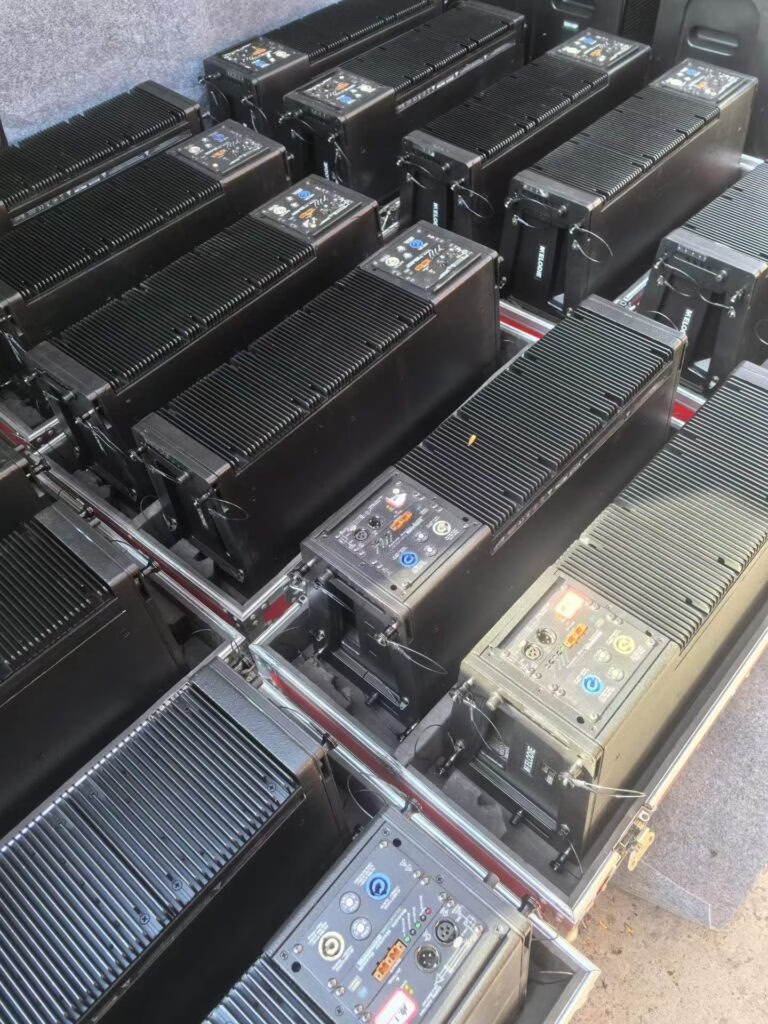
On the back panel near the power inlet, or on a sticker under the unit. It reads something like “100-240V~ 50/60Hz 180W”. The watt figure is the one you need for converter sizing. If the label is missing or unreadable, ask for a photo before you buy; a missing rating is a reason to slow down.
What does a converter need to handle?
| Gear | Typical draw | Converter size |
|---|---|---|
| Mixing console | 80-180 W | 300 W |
| Active monitor pair | 150-300 W | 500-600 W |
| Power amplifier | 600-1,500 W | Transformer, not a box |
| CDJ / deck | 30-40 W | 100 W |
Amplifiers are the exception. A 1,000 W amp draws peaks far above its rating, and the cheap converter boxes sold for travel cannot supply that. Use an autotransformer rated for the full load, or buy gear with a multi-voltage supply.
What is different about 100 V Japanese gear?
Japan runs 100 V, not 110 or 120. Running a 100 V unit on 120 V pushes its internal rails about 20% high, which shortens capacitor life and can trip protection circuits. In a 230 V country you need a proper step-down transformer, and it must be rated for continuous load, not just peak. That is a $60-150 item for a console, and it should sit outside the rack where it can breathe.
Does frequency matter?
For 50/60 Hz gear, no. For anything with a synchronous motor, yes: turntables, tape machines and some older fans spin at the wrong speed on the wrong frequency. A 60 Hz turntable on a 50 Hz supply runs 17% slow, and no voltage converter fixes that.
What are the practical rules?
- One converter per device, or one large transformer with a clearly marked distribution strip.
- Leave 40-50% headroom on the converter; they get hot at full load.
- Never chain two converters. Buy the right single unit.
- Keep converters off the floor and away from carpet.
- Label each plug with its voltage so a guest engineer does not fry a unit.
If you are buying a rig in one order, ask the seller for back-panel photos of every unit before shipping. It takes five minutes and saves a whole class of problems. If you are also choosing speakers, our note on used powered PA speakers covers which models handle multi-voltage input cleanly.
Is a converter ever the wrong solution?
Yes, when the gear is fixed-voltage and expensive to convert. A rack of three fixed-120 V amplifiers plus three transformers is a bad system: more points of failure, more heat, more weight. In that case, buy gear rated for your region instead, even at a higher price. The converter is a bridge, not a way of life.
What about rack gear with an external supply?
Many small units use an external wall supply, and that is good news: a replacement 12 V or 18 V supply is $10-25 and comes in your local voltage. Check the barrel plug polarity and size before ordering, because two 12 V supplies can look identical and be wired opposite. Getting polarity wrong is instant damage.
If the original supply is missing, budget for the replacement and factor it into the offer. A rack unit sold without its supply is not broken, it is just incomplete, and that is worth 5-10% off.
One extra check for mixed rigs: count total load on each circuit. Three amplifiers and two converters on one 16 A circuit can sit at 3,000 W, and a venue with old wiring will not enjoy that. Split the rig across two circuits before you add conversion hardware.
Key Takeaways
- Check the input label: 100-240 V means you need only a plug adapter.
- Size a converter at 1.5-2x the device wattage and leave headroom.
- Japanese 100 V gear needs a real step-down transformer, not a travel adapter.
- 50/60 Hz matters for turntables, not for most modern audio electronics.