What has aged badly?
Connectivity. The DM1000 has ADAT and AES/EBU options, not class-compliant USB. Getting 16 tracks into a laptop takes an interface or a card you have to hunt for. Scene management is also clunky by 2026 standards: no tablet app, no remote mixing from the room, and show files move around on old media formats.
One more limit: the desk is heavy and awkward for one person to move. A 22 kg console in a case is a two-person lift down stairs, every show.
Who should buy one?
Three groups: churches with a fixed booth that need more inputs than a 16-channel desk allows; broadcast or podcast rooms that want a physical desk with no screen glare; and rental houses that already have DM-series desks and want spares and a matching second surface.
Who should skip it: touring engineers who need USB multitrack, volunteer-run venues with no training time, and anyone who expects firmware updates in 2026. There will not be any.
How do you check one before paying?
- Recall 8 scenes in a row and confirm every fader moves to the right position.
- Check the display for dead pixels; a replacement panel is scarce.
- Test every input for noise with a mic, not just one.
- Confirm the option cards installed match what the seller advertises.
If a fader sticks or a channel is dead, that is a $100-200 repair at a good tech, or a genuine reason to walk away at above $900.
How do you compare them without a demo room?
Read the block diagram, not the brochure. On a digital desk the routing matrix tells you whether monitors and front of house can run independently, which is the feature small venues use most. On an analog desk, count the aux sends: four is workable, two is not enough for a band with monitors.
What about support and spare parts?
This is where the digital vs analog argument turns on age. A 2008 analog desk has generic parts inside and any competent tech can service it. A 2010 digital desk may need a display or a mainboard nobody stocks. Before buying digital, search the model number plus “screen replacement” and see whether people are selling parts or just complaining.
Weight and power matter too. A large analog desk can draw 600 W and weigh over 100 kg, so it needs a truck and two people every time it moves. A 16-channel digital desk fits in a car boot and runs from a standard outlet, which beats any spec sheet if you play small rooms four nights a week.
Key Takeaways
- Used DM1000 price in 2026: $900-1,400 with meter bridge.
- Still strong: 48 inputs, clean preamps, solid motor faders.
- Aged badly: no USB audio, no tablet control, no firmware updates.
- Best for fixed installs and broadcast rooms, worst for touring.
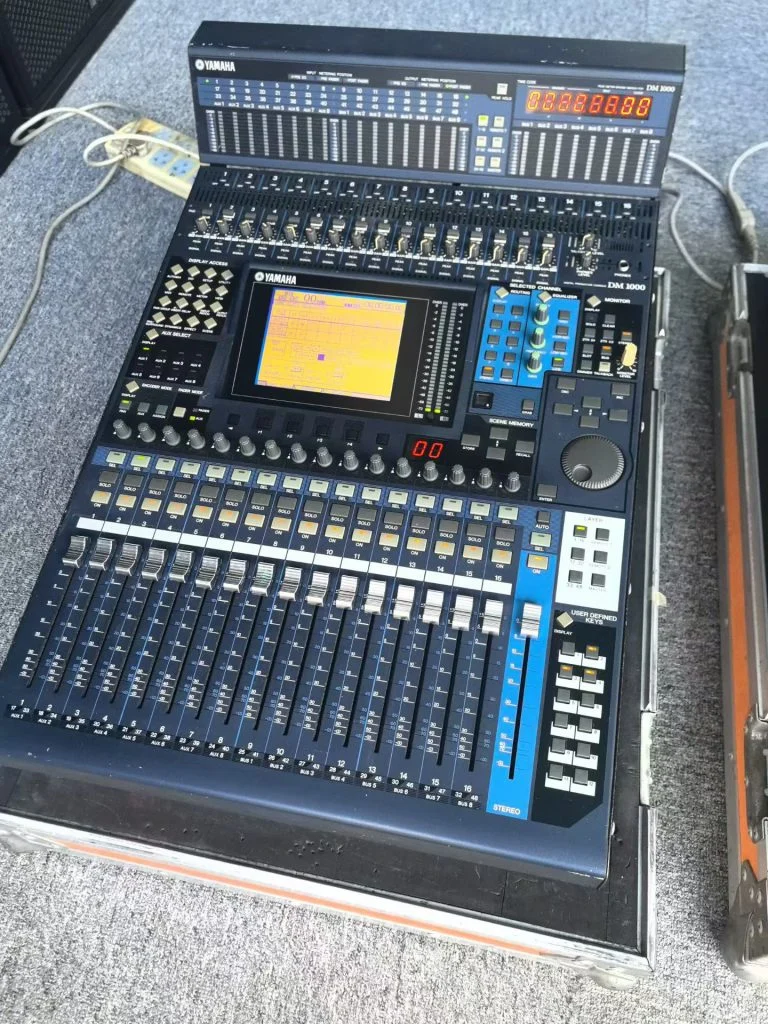
Yes, with conditions. A used Yamaha DM1000 sells for $900-1,400 in 2026 and still offers 48 input channels, 16 motorized faders and 96 kHz processing. Buy it for fixed installs, church sound and broadcast desks where it will sit in one place. Skip it if you need USB audio, tablet control or software that is still being updated.
The DM1000 launched in 2004 as the compact member of Yamaha’s DM series. Two decades on, the question is not whether it sounds good, it is whether the workflow and parts supply still make sense for your room.
What does a used DM1000 cost in 2026?
Working units with the meter bridge land at $900-1,400. Without the bridge, knock off $150-250. Units with a failed fader bank sit at $500-700 and are only worth it if you can source fader assemblies. Expect a case and power cable to add freight weight: the desk is around 22 kg.
What still holds up?
- Channel count. 48 inputs in a 22 kg frame is still a strong ratio.
- Preamp quality. The head amps are clean and quiet; nobody complains about the sound.
- Fader feel. The motor faders are solid, and the layout is fast to learn.
- Stability. A desk that has run for 15 years in one room usually keeps running.
You can see how one of these desks is documented and photographed on the Yamaha DM1000 page, which lists the channel count and I/O for the exact unit.
What has aged badly?
Connectivity. The DM1000 has ADAT and AES/EBU options, not class-compliant USB. Getting 16 tracks into a laptop takes an interface or a card you have to hunt for. Scene management is also clunky by 2026 standards: no tablet app, no remote mixing from the room, and show files move around on old media formats.
One more limit: the desk is heavy and awkward for one person to move. A 22 kg console in a case is a two-person lift down stairs, every show.
Who should buy one?
Three groups: churches with a fixed booth that need more inputs than a 16-channel desk allows; broadcast or podcast rooms that want a physical desk with no screen glare; and rental houses that already have DM-series desks and want spares and a matching second surface.
Who should skip it: touring engineers who need USB multitrack, volunteer-run venues with no training time, and anyone who expects firmware updates in 2026. There will not be any.
How do you check one before paying?
- Recall 8 scenes in a row and confirm every fader moves to the right position.
- Check the display for dead pixels; a replacement panel is scarce.
- Test every input for noise with a mic, not just one.
- Confirm the option cards installed match what the seller advertises.
If a fader sticks or a channel is dead, that is a $100-200 repair at a good tech, or a genuine reason to walk away at above $900.
How do you compare them without a demo room?
Read the block diagram, not the brochure. On a digital desk the routing matrix tells you whether monitors and front of house can run independently, which is the feature small venues use most. On an analog desk, count the aux sends: four is workable, two is not enough for a band with monitors.
What about support and spare parts?
This is where the digital vs analog argument turns on age. A 2008 analog desk has generic parts inside and any competent tech can service it. A 2010 digital desk may need a display or a mainboard nobody stocks. Before buying digital, search the model number plus “screen replacement” and see whether people are selling parts or just complaining.
Weight and power matter too. A large analog desk can draw 600 W and weigh over 100 kg, so it needs a truck and two people every time it moves. A 16-channel digital desk fits in a car boot and runs from a standard outlet, which beats any spec sheet if you play small rooms four nights a week.
Key Takeaways
- Used DM1000 price in 2026: $900-1,400 with meter bridge.
- Still strong: 48 inputs, clean preamps, solid motor faders.
- Aged badly: no USB audio, no tablet control, no firmware updates.
- Best for fixed installs and broadcast rooms, worst for touring.