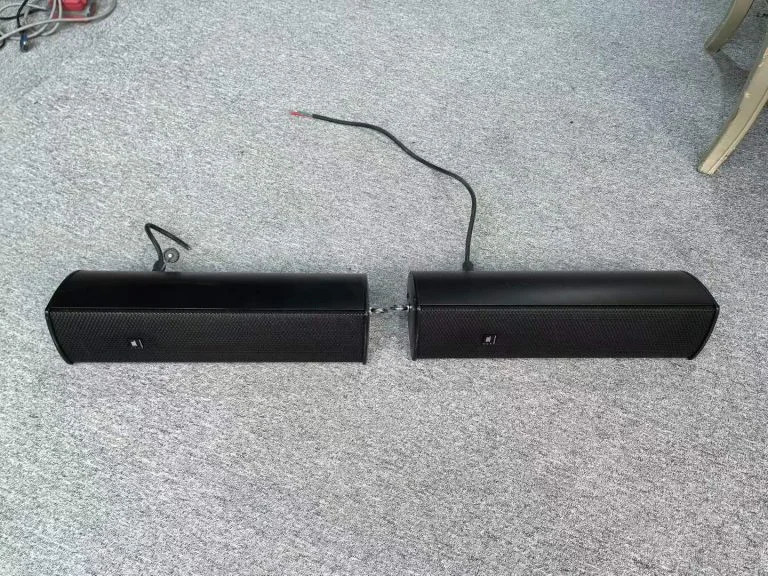
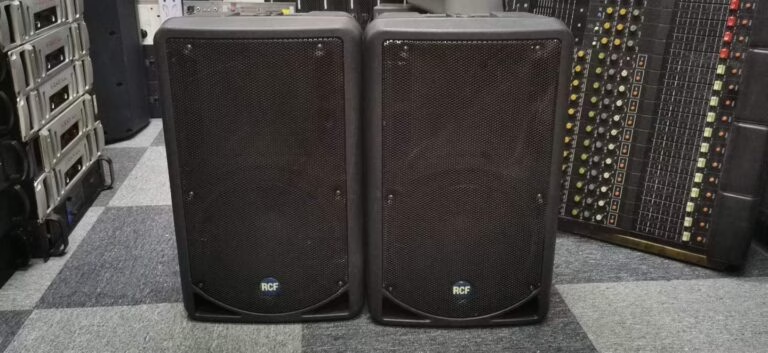
Because they come in groups, not because they are broken. A hotel that renovates a ballroom pulls 60 identical boxes off the wall in one week, and a rental company that changes its line array dumps 120. Single-unit pricing does not survive that kind of volume, so the per-cabinet price falls to $95 to $140 landed.
What makes the price so low?
| Factor | Effect on price |
|---|---|
| Lot size 40-200 units | -35 to -50% |
| Wall-mounted, indoor use only | -15% |
| Paint scuffs from grille removal | -10% |
| Missing original packaging | -5% |
Indoors matters more than people think. A passive 10 inch box that spent 8 years in a climate-controlled ballroom has far fewer cone problems than one that toured in a humid region.
What is wrong with the cheap ones?
Three things, typically. Scuffed paint on the baffle from installers using a screwdriver to wedge off the grille. Crossovers with dried capacitors after a decade at low duty cycle, which shows as a thin sound rather than silence. And mismatched revisions inside a single lot, because facilities teams replace dead units one at a time over years.
None of these is fatal. A crossover recap is $8 to $15 in parts if you can solder.
What should you demand before buying a lot?
- Photo of every serial label, or a scanned spreadsheet of them
- Count of how many units have been opened for repair
- Confirmation that all grilles are original and present
- A single tested reference unit shipped ahead
Testing one unit ahead of a 120-unit container is the single best money you will spend. It tells you whether the batch sounds like a batch.
How do you make money on a bulk lot?
Sell in pairs to venues, not singles. A venue that needs 6 boxes buys 8 when the price per pair is right. Grade the lot into three tiers on arrival and price each tier separately: clean, working-but-scuffed, and parts. Tier three covers the dead units that you factored in at 10 percent.
See actual condition and volume on the JBL KP4010 bulk lot page, or the single unit listing for JBL KP4010 passive 2-way 10 inch speakers.
Key Takeaways
- Bulk lots land at $95 to $140 a cabinet versus $180 to $260 for single units.
- Low prices come from volume and indoor-only use, not from universal defects.
- Dried crossover capacitors are the most common hidden issue after 10 years.
- Test one unit ahead of the container, every time.
- Sell in pairs and grade the lot into three tiers on arrival.
How do you split a lot into sellable tiers?
Grade on arrival, not on the seller’s word. Tier one is clean and original, roughly 55 to 65 percent of a good lot, and sells at $220 to $260. Tier two is working with cosmetic damage, 20 to 30 percent, and sells at $140 to $180. Tier three is dead drivers or cracked baffles, 8 to 15 percent, and sells as parts for $30 to $60 each, which usually covers the cost of the dead units.
Photograph every tier on the day it is graded. Buyers of tier two ask for photos and you will not want to unwrap a pallet twice.
What is the actual profit on a 120-unit lot?
A worked example. Landed cost $120 per unit, so $14,400 in. Sell 72 at tier one for $230, 30 at tier two for $160, and 18 as parts for $40. Gross revenue is $16,560 plus $4,800 plus $720, or $22,080. Subtract $1,200 of repair parts and labour and you are at about $6,480, a margin near 29 percent over roughly 10 weeks.
What kills the margin?
- Selling slowly: storage rent eats 1 to 2 percent of margin per week
- Repairing dead units instead of parting them out
- Accepting returns on cosmetic complaints you did not document