Usually yes. Used powered pairs trade at 500-900 USD against 1,200-1,600 new, and you skip buying amplifiers. The catch is the amp module: if a replacement is still orderable the risk is a 200-400 USD repair, and if not, it is the whole purchase.
What does used powered PA actually save you?
A pair of 10-inch powered boxes that retailed at 1,200-1,600 USD trades at 500-900 USD in 2026. That is 40-60% off, and unlike passive cabinets you are not buying amplifiers separately, so system cost drops further.
The RCF ART 310 is a fair example. Two-way active, 10-inch, about 12 kg each, and a working pair sits at 600-800 USD. It is a box one person can carry to a pole. For a room of 100-150 guests that is enough.
Compare it honestly with the new price of a similar cabinet, then add the 150-300 USD you would spend on a passive pair’s amplifier. The powered saving is real but smaller than the sticker suggests.
Do not forget flight cases and stands. A used pair that comes with cases is worth 150-250 USD more than an identical pair without, because you will buy the cases anyway and shipping a bare cabinet damages it about one time in five.
What breaks first on a powered speaker?
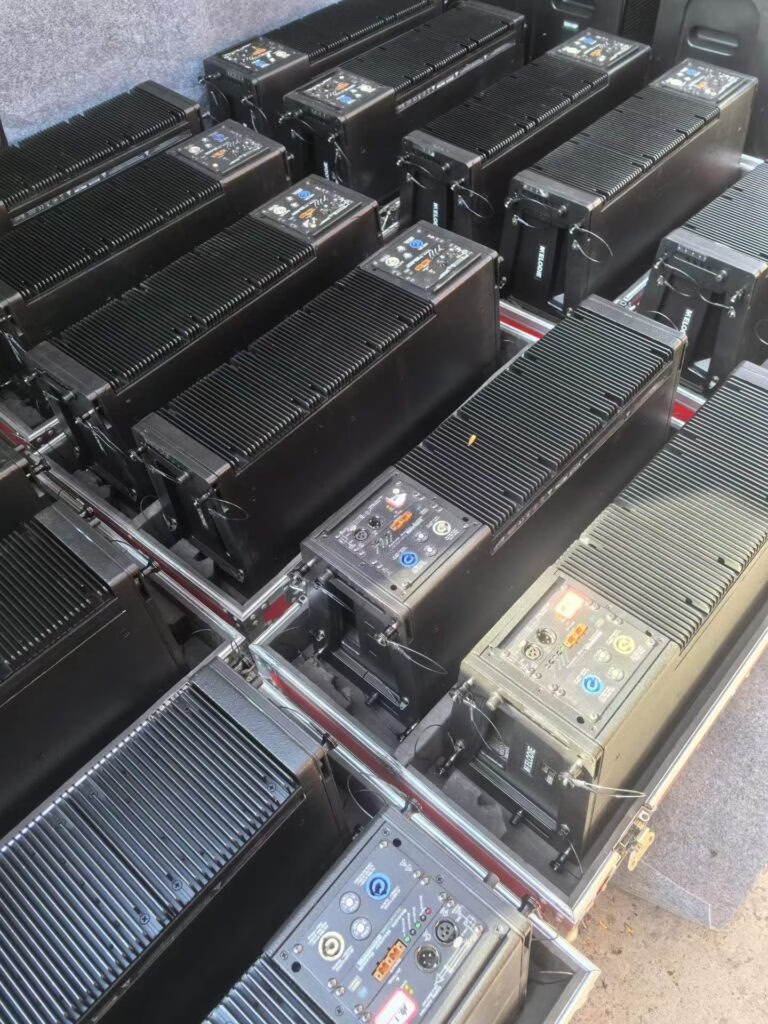
The amplifier module, specifically its power supply. Class D output stages are reliable. The switching supply and the DSP board that lives next to the heat sink are what fail, and on a 2010-2015 cabinet the OEM module is often discontinued.
The second failure is the DSP itself. If the box has presets and that board dies you get a speaker that powers on and makes no sound, or one channel only. Check every input, every preset and the link output before money changes hands.
Third is fan noise. Listen in a quiet room with no signal. A fan that rattles at idle will be audible from a metre away in a small venue, and you will hear it on every quiet passage.
Fourth, the one people skip: run it at full level for twenty minutes. Thermal faults and dry joints appear when the heatsink is hot, not when the box is cold in a warehouse. A seller who will not allow that is telling you something.
Fifth is the cabinet itself. Powered boxes carry a lot of weight in a small volume, so the handles and the pole socket take the strain. Rock the box on its pole mount. Any movement there means the socket has cracked its mounting board, and that is a 100-200 USD repair nobody quotes upfront.
Which powered speakers are safe to buy used?
Brands that still publish service parts. If you can order a replacement module today the risk is a 200-400 USD repair. If you cannot, the risk is the whole purchase.
Shared platforms help. A K-array KF12 self-powered two-way speaker, with twelve units in stock, means the seller has seen them running and can swap a module between cabinets to prove a fault. That is worth more than any label.
Age matters more than badge. Anything built before about 2012 used bigger, hotter transformers and fewer protection circuits. Not a reason to reject it, a reason to open the back and look for bulged capacitors first.
Where does powered lose to passive?
Long runs and outdoor work. A powered box needs mains at the speaker. On a 40-metre run to a delay tower that means a generator and a cable, plus the hum that follows. Passive cabinet plus one amplifier at the rack is cleaner and quicker to rig.
Heat is the second. Two powered 12-inch boxes in direct sun at 35 degrees will thermal-throttle. Passive cabinets do not care.
Rigging is the third. A delayed tower with four powered boxes needs power distribution, breakers and a safe route for the mains. That is an electrician conversation. One amplifier at the rack and two speaker cables needs neither.
Resale is the third. Powered boxes lose value faster because the electronics date them. A 2005 passive cabinet is still a passive cabinet. A 2005 powered one is a repair waiting on a part that no longer exists.
So is it worth it?
Yes, with conditions. The pair is under 60% of new, the amplifier module is still available as a part, and you tested it at full level for twenty minutes rather than thirty seconds.
No if the module is discontinued, the DSP is sealed and undocumented, or the seller cannot tell you the year. An unknown amplifier vintage at 600 USD is too much to gamble.
One middle path works well: buy a working pair and one spare module if you find one. At 200-300 USD for a used module, having it on the shelf turns a show-ending failure into a ten-minute swap, and it makes the pair resellable in three years.
Key Takeaways
- Powered pairs run 40-60% under new, and you skip the amplifier purchase entirely.
- The failure point is the amplifier module and its switching supply, not the drivers.
- Only buy used powered boxes whose replacement modules you can still source today.
- Test at full level for 20 minutes; thermal faults never show up in the first minute.