Most buyers overpay by 20-30% because they price from the asking number instead of the new price. A tested Yamaha DM1000 trades at 1,800-2,600 USD in 2026, passive 12-inch pairs at 150-450 USD, and a 20 kg touring amp costs 120-180 USD to ship by sea.
What does a used mixing console actually cost in 2026?
A working digital console loses roughly 55-65% of its new price over eight years, and that curve is fairly flat across brands. A Yamaha DM1000 from 2004 sold new for about 7,500 USD. Today a tested unit with a flight case trades at 1,800-2,600 USD.
Twenty-four-channel analog desks sit lower. An Allen & Heath GL2600 with working faders and no scratchy pots lands at 700-1,100 USD. If a seller wants 400 USD for one, ask why. Usually the answer is a dead channel strip or a power supply that hums.
Forty-input digital desks from 2013 onwards are the awkward middle. Too new to be classics, too old to fetch a premium, so an X32 in good order trades at roughly half its new price. Ignore the model year and look at fader count and I/O.
The jump people underestimate is service history. A console that spent a decade on a rental fleet needs new faders at 12-18 USD each. Thirty-two of them is 500 USD before anybody picks up a screwdriver.
Prices are regional as well. The same DM1000 that fetches 2,400 USD in Hamburg sells for 1,900 USD in Nairobi and 3,100 USD in Sao Paulo, because duty and local supply do the work. Compare landed cost across countries, never the number on the screen.
Where do prices go wrong on speakers?
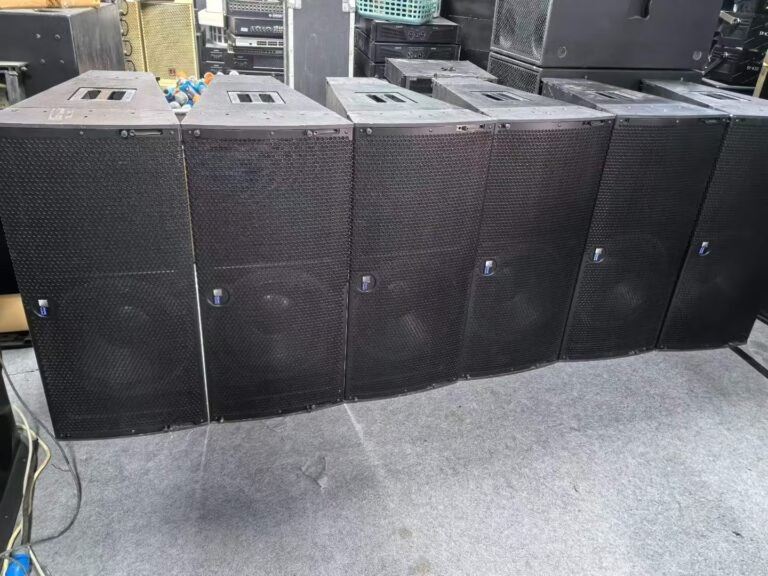
Passive 12-inch two-way boxes are the cheapest reliable product in this market. 150-450 USD a pair for working cabinets is normal in the UK, and 120-350 USD in East Africa where freight nudges the figure up.
Powered cabinets run 2-3x that. A pair of powered 10-inch boxes with original amplifiers goes for 500-900 USD. The amplifiers are the expensive half, and a failed Class D module on a 2012 cabinet often has no affordable replacement.
The Behringer X32 Producer shows the same pattern on the console side: 40 inputs, 2,000-2,800 USD used in 2026, against about 5,200 USD new. You are buying the I/O count, not the badge.
Subwoofers are their own market. An 18-inch cabinet is cheap until you have to move it. A dual-12 active sub at 35 kg is the practical limit for one person, and anything heavier needs two people and a ramp, which is why big subs sell for a fraction of new.
When is a used amplifier a bad deal?
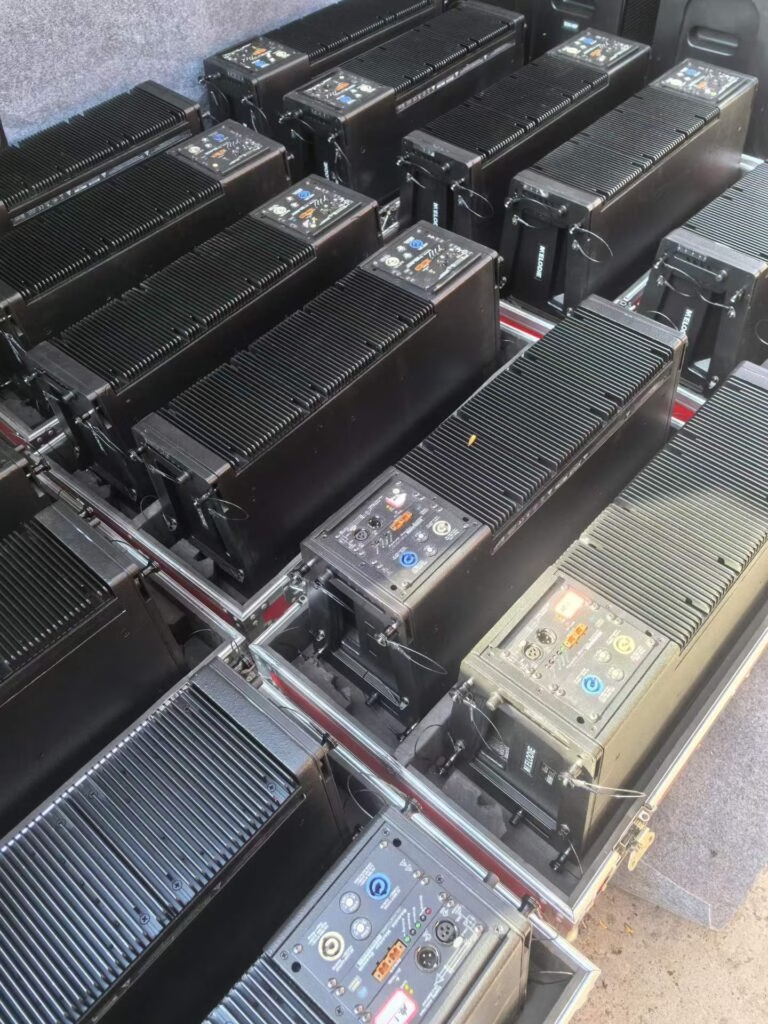
Almost always when it is heavy and old. A touring amplifier at 20 kg costs real money to ship: 120-180 USD by sea from China to a European port, plus inland carriage. If the amp is worth 300 USD, freight is a third of the total spend.
Amplifiers with switch-mode supplies and no service documentation are the ones I would avoid. If the maker folded and the output module is a custom part, one failure turns a 400 USD amp into scrap.
Weight is not automatically bad. A ten-unit rack of MC2 Audio T45 amplifiers is heavy precisely because it was built to be repaired. Ask for a schematic before you ask for a discount.
A rule of thumb that has held up: if the amplifier’s second-hand value is less than twice its shipping cost, walk away. That single test filters out most of the bad lots in the 200-400 USD range.
What about microphones and DJ gear?
Dynamic mics barely depreciate. A Shure SM58 keeps about 70% of its value for fifteen years because nothing inside fails quietly. Condensers drop faster, 45-60% in five years, because capsules age and no photo can show it.
Used DJ gear is the worst category to price from a description. A two-channel mixer at 150-350 USD might be fine or might have a crossfader with 40,000 cycles on it. Ask for the cycle count if the unit reports one.
Wireless is different again. A Shure UR2 handheld transmitter set with Beta 58A capsules holds value because the RF section either works or does not, and anyone can hear that in five minutes. Expect 40-55% of new for a clean set.
How do you set your own ceiling price?
Work backwards. Take the new price, subtract a full service, subtract freight, then decide what margin makes the risk worth taking. A 2,000 USD console that needs 600 USD of faders and shipping has a bid ceiling around 1,100 USD.
Then check two things before paying. That the seller sends a photo of the serial plate, and that they run a signal through every channel on video. Refusing either means you are being asked for near-new money on an untested unit.
If you are sourcing out of China, bundle the shipment. Three consoles in one 20-foot container share the freight. One console does not.
Write the number down and do not move it. The expensive mistake is not overpaying by 200 USD on the first unit. It is agreeing a price on Monday because the seller was charming, then seeing two identical units sell for 400 less on Thursday.
Key Takeaways
- Digital consoles land 55-65% under new after eight years; analog desks hold up better when the faders are original.
- Passive 12-inch pairs trade at 150-450 USD; powered pairs at 500-900 USD, and the amplifier is the part that fails.
- Freight changes the maths: 20 kg of amplifier costs 120-180 USD to move by sea.
- Set a ceiling by subtracting service and freight from the new price, not from the asking price.