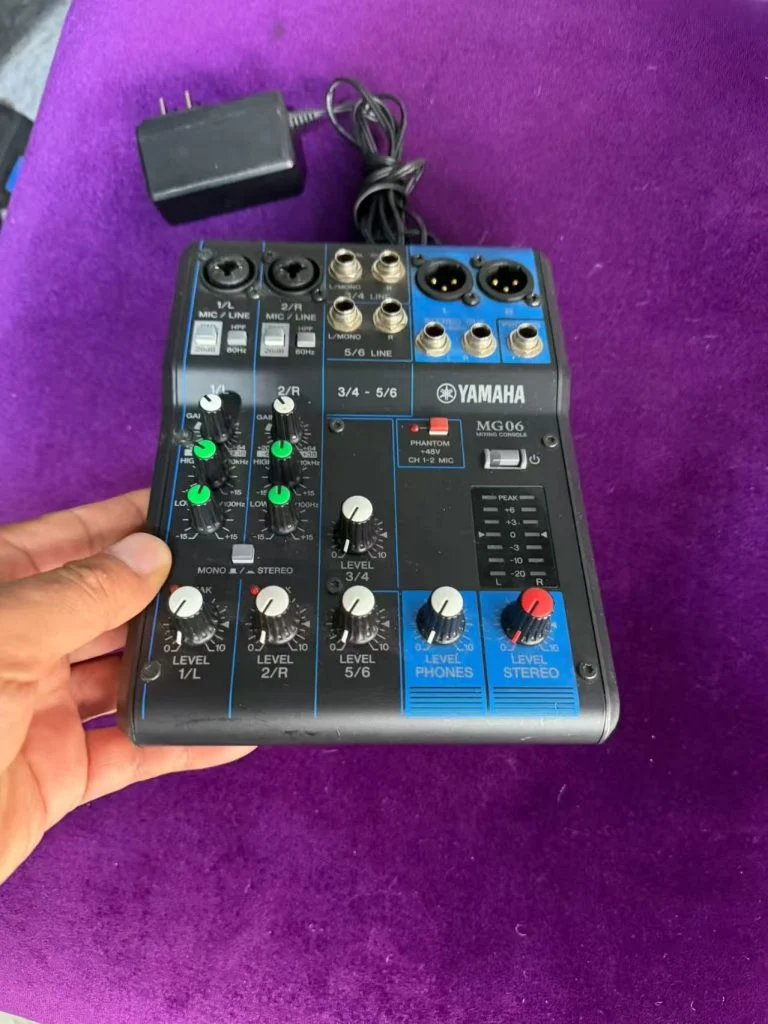
Yes, for small rooms and anyone who mixes by feel. A used 16-channel analog desk runs USD 250-900, boots instantly, and every control is visible at once. The trade is real: no scene recall, 15-30 kg of weight, and channel strips that fail individually once the desk passes 15 years old.
Analog consoles never really left the small-venue market. What changed is who buys them. Rental houses moved digital in 2015-2020 and dumped thousands of analog desks onto the secondhand market. That supply has kept prices flat for a decade while digital desks fell.
What does analog still do better than digital?
- Zero latency monitoring – no conversion round trip on the monitor path.
- Instant operation – no boot, no firmware, no ‘wait for the desk’ moment on a cold stage.
- One control per function – a volunteer can learn a 12-channel desk in an hour.
- Repairability – through-hole components and published schematics on most 1990s-2000s units.
There is also a sound argument, though a weaker one than forums suggest. A decent analog desk introduces a little harmonic character. Whether that is better than a clean digital path depends on the music. For rock and soul, many engineers prefer it. For corporate speech, clean wins.
What goes wrong on a 20-year-old desk?
| Problem | Typical age | Cost to fix |
|---|---|---|
| Scratchy pots and faders | 10+ years | USD 5-20 per part, plus labour |
| Dead channel | 15+ years | USD 30-90 |
| Power supply caps bulging | 18+ years | USD 40-120 |
| Cracked solder joints on inserts | 20+ years | Bench time only |
| Missing knob caps / bent fader stems | any | Cosmetic, ignore |
The power supply is the one to worry about. A bulging cap can take out a whole rail and with it several channels. Ask for a photo of the PSU board, and if the seller will not send one, assume the worst.
Analog or digital for a small venue in 2026?
A working rule: under 12 inputs with no scene changes, analog. Over 16 inputs, more than one operator, or anything with a matrix requirement, digital. The Yamaha DM1000 covers the digital side with 48 channels and 8 matrices for USD 1,400-2,500 used.
The middle ground is a 16-channel analog desk plus a digital multichannel interface. That gives you recall on the recording side without paying for a full digital console. It is a good compromise for rehearsal rooms that multitrack sessions.
What should you check before buying used analog?
- Test every channel with the same mic and cable, not different ones.
- Push every fader through its full travel and listen for crackle.
- Turn every aux send to 100% and confirm no channel is silent.
- Check the phantom power switch on each channel individually; group-only phantom is a common cheap design.
- Lift the desk and shake gently; rattles mean loose hardware or a loose transformer.
How does it pair with modern speakers?
An analog desk into a pair of passive boxes is the simplest reliable system there is. Our JBL KP4010 speakers plus a 16-channel analog desk and a 350 W amp is under USD 800 used and will run a 100-capacity bar without a single menu.
Key Takeaways
- Used 16-channel analog desks run USD 250-900; digital equivalents start around USD 1,400.
- Analog wins on latency, simplicity and repairability; loses on recall and weight.
- The power supply is the highest-risk part on a desk over 18 years old.
- Under 12 inputs with no scene needs, analog is still the sensible buy.