No for 220-240V countries — most Chinese pro audio ships wired for that and needs nothing. Yes for 100-120V countries like the US, Canada, Japan and parts of Latin America, where you need a step-down transformer sized at 1.5-2 times the rated consumption. Plugs are a separate, cheaper problem.
What voltage is the gear actually set to?
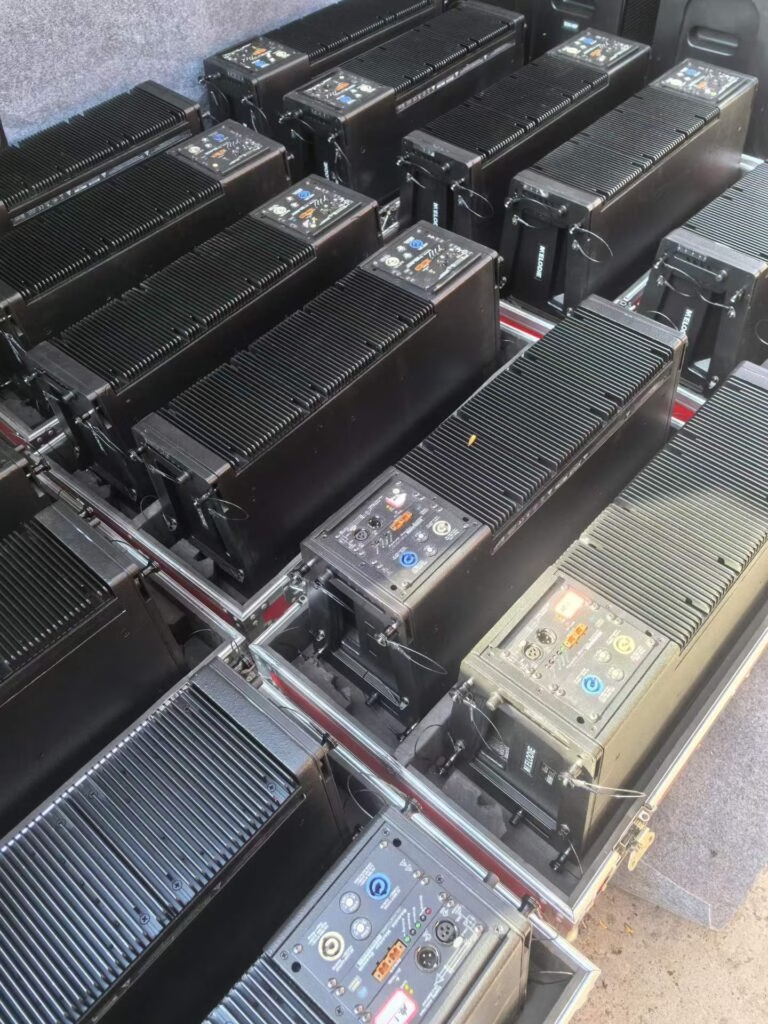
Look at the rear panel label. Most Chinese amplifiers and powered speakers are built for 220-240V at 50 Hz, and many have a switchable 110V tap or a dual-winding transformer with two input lugs.
This is the single most useful photo to request before buying. A 220V-only amp in a 120V market means a converter, and a big one.
When is rewiring enough?
Some amplifiers and powered speakers have a 110/220 selector or a dual primary transformer where you move two spade connectors. A tech can flip that in 20-40 minutes for $40-100.
Do not do this yourself unless you are comfortable working on mains. A mistake there is a fire, not a repair. Class-D modules and switch-mode supplies often auto-sense 100-240V and need nothing at all.
How big a converter do you need?
Size for peak draw, not average. An amplifier rated at 2 x 500W draws roughly 1,200-1,500W from the mains at clipping; transformers lose 10-15% on top. Multiply the rated wattage by 1.5 to 2.
| Gear | Rated output | Mains draw (peak) | Converter size |
|---|---|---|---|
| 2 x 500W amp | 1000W | 1,200-1,500W | 2,000-3,000W |
| Single 12″ powered speaker | 800-1000W class | 500-700W | 1,000-1,500W |
| 24ch digital console | — | 150-250W | 500W |
| DJ controller + laptop | — | 60-120W | 300W |
What about frequency: 50 vs 60 Hz?
Most modern solid-state gear runs on either. What does not: older turntables, some tape machines, and anything with a synchronous motor or a mains-derived clock. In a 60 Hz country, a 50 Hz synchronous motor runs 20% fast.
Digital consoles and switching supplies handle 50/60 Hz automatically. If the spec sheet says 50/60 Hz, you are fine.
Plugs, earthing and one cheap trap
Plug adapters cost $2-5. Do not use a travel adapter on a 2,000W amplifier — the contacts are rated for 5-10A and will heat.
Earthing is the real trap. A converter that floats the earth can leave your chassis live and add hum. Use an isolating transformer with a proper earth path, and test with a socket tester before powering anything expensive. If you are pairing imported self-powered speakers with an imported amp, test the whole chain once, not each box separately.
Key Takeaways
- 220-240V countries: usually nothing to do beyond a plug adapter.
- 100-120V countries: step-down transformer at 1.5-2x rated draw.
- Many amps have a 110/220 tap — a tech can rewire for $40-100.
- 50/60 Hz is fine on solid-state gear, not on synchronous motors.
- Never run a 2kW amp through a $3 travel adapter.
Ask for the rear-panel photo before ordering from the used amplifier category.