Buy used if the box has a serviceable amp module and the cabinet is not warped. Skip it if the speaker is a sealed-plastic budget model from 2012 with no parts channel. That single distinction decides whether you save $400 or lose $600.
Powered speakers are the one category where “used” is genuinely a smarter buy than “new” — but also the one where a bad buy hurts most, because the failure mode is total silence, not a scratchy fader.
What do used powered speakers actually cost?
Real 2026 export prices from China, tested and crated:
| Box | Used price | New price |
|---|---|---|
| 12-inch powered, tier 1 | $680-820 | $1,400-1,900 |
| 12-inch powered, generic | $350-500 | $700-900 |
| 15-inch powered sub | $500-750 | $1,100-1,500 |
| Line array element | $900-1,600 | $2,200-3,200 |
What is the 83% rule, and does it apply to used gear?
The 83% rule is a rough guide borrowed from room acoustics: speakers should sit at about 83% of the room’s short dimension apart, and listeners about 83% of that distance back. It is not a law, and it does not change with used vs new. What matters is that a $700 used box placed badly sounds worse than a $400 new box placed well.
Most people buying used PA gear spend 90% of the budget on boxes and 0% on figuring out where they go. Backwards.
Which checks matter on a used powered speaker?
- Power it on cold. Listen for a thump or a fan that starts loud then drops — that is a sick capacitor.
- Play at 80%, not 20%. Thermal faults only show up under load.
- Test both inputs. A dead XLR input means a $40 jack or a $250 board.
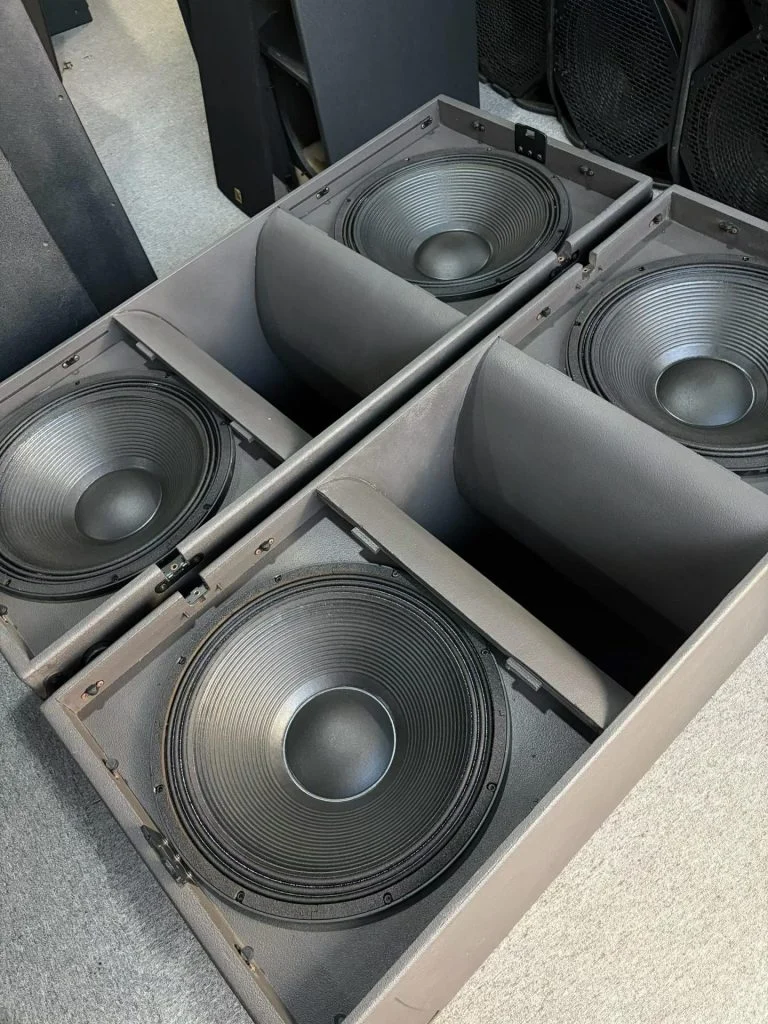
- Look in the horn throat for dust and foam rot.
- Check the LF driver surround — foam degrades at 12-15 years, rubber lasts longer.
Our K-array KF12 self-powered 2-way speaker units are tested on those five points before they leave, with photos of the horn throat and cone. That is the level of detail to demand from any seller.
What is the biggest risk?
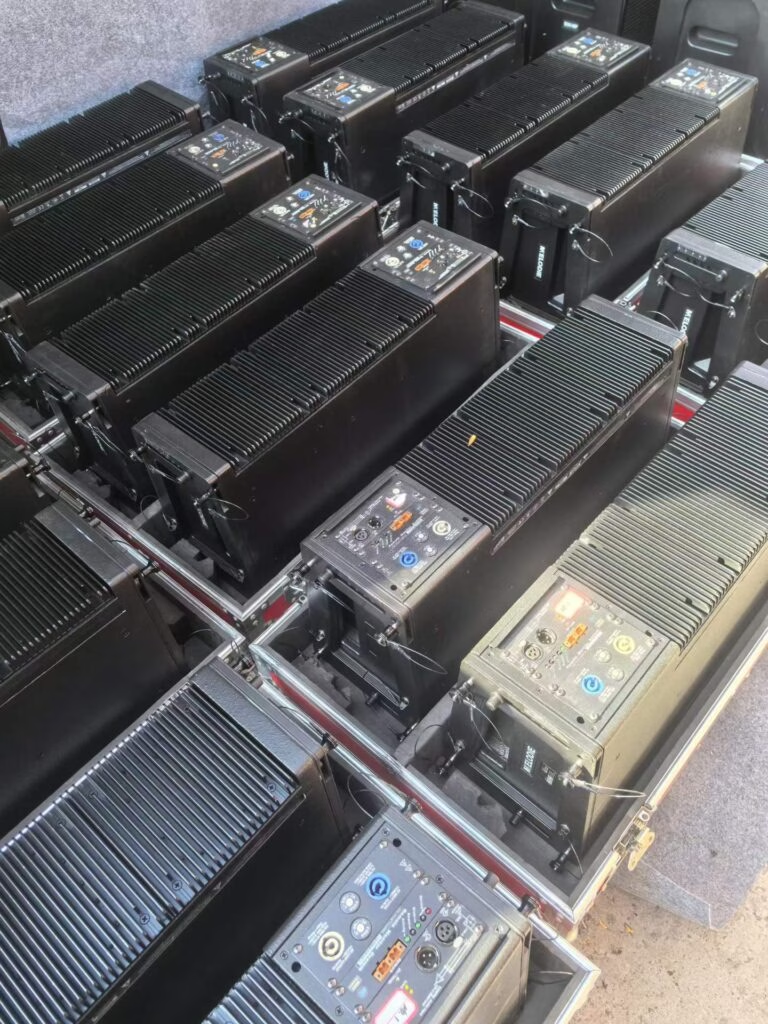
The amp module. If it dies and the manufacturer no longer stocks it, you own a cabinet with a hole. Class-D modules fail in a harsh way: they usually take the power supply with them, and repair cost runs $250-400 including labour. On a $400 speaker, that is a write-off.
It is why we tell buyers to avoid 2010-2015 sealed plastic boxes with proprietary DSP. Go for wood or polypropylene cabinets with accessible amp plates, because a plate can be swapped. A moulded box with foam-glued boards cannot.
Used vs new: where does each win?
| Factor | Used | New |
|---|---|---|
| Price per box | $680-820 | $1,400-1,900 |
| Warranty | 30-day DOA typical | 2-3 years |
| Ecosystem lock-in | None | Often tied to one control app |
| Repair risk after year 5 | Medium | Low to medium |
| Resale at year 3 | 60-70% | 40-50% |
If you are a rental house that beats gear up and needs same-week warranty, buy new. If you are a venue that racks the speakers and never moves them, used wins on total cost almost every time.
Compare the whole used speaker range on landed cost per box rather than sticker price, and factor freight at $180-320 per crate for sea LCL.
Key Takeaways
- Used powered 12-inch boxes run $680-820 per unit versus $1,400-1,900 new.
- The amp module is the whole risk — check it can be swapped before you buy.
- Test at 80% level, not whisper level; thermal faults hide at low volume.
- Foam surrounds rot at 12-15 years; rubber lasts longer.
- Placement matters more than the used/new choice. Budget for it.