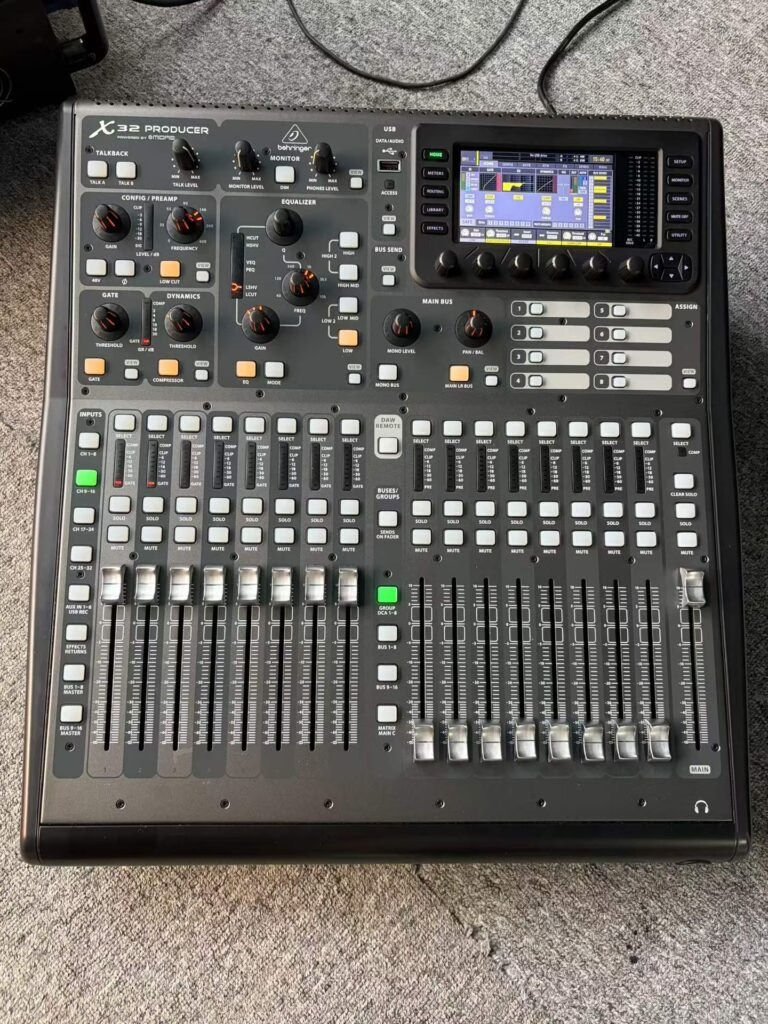
Buy digital if you mix the same show twice and want recall. Buy analog if you want a desk you can fix with a soldering iron and understand at a glance. That is the whole decision in one line. Everything else — price, weight, channel count — follows from which of those two you actually are.
What does a used digital console give you that analog cannot?
Recall. Save a scene, come back next week, and every fader, gate, compressor and EQ is exactly where you left it. On a 48-channel digital desk that is dozens of hours saved per tour. Built-in dynamics and EQ also mean you skip a rack of outboard gear and a pile of cables.
The Yamaha DM1000 is a good example of why this matters. It is a 48-channel / 96 kHz digital console with 16 mic/line inputs and 16 motorized faders, and it still trades used for a fraction of what comparable analog-plus-outboard used to cost. You can see the current Yamaha DM1000 unit here with its full spec.
When is analog still the smarter buy?
Analog desks survive bad power, bad advice and bad weather. There is no boot time, no firmware, no menu tree. If a channel dies you can often swap a card or a chip. For a small club, a rehearsal room, or a band that wants knobs under their fingers, a used analog desk is honest and durable.
Digital vs analog: the honest comparison
| Used digital | Used analog | |
|---|---|---|
| Recall of settings | Full scenes | None (photos/notes) |
| Built-in EQ/dynamics | On every channel | Usually none |
| Repair | Board/service part | Often component-level |
| Boot time | 30-90 sec | Instant |
| Typical used price | $800-$6,000 | $300-$4,000 |
| Learning curve | Menus and layers | One knob, one job |
Which one holds its value better?
Older analog classics can appreciate if they are a famous model in clean shape. Most digital desks depreciate faster because the next firmware generation makes them look dated, even when they still work perfectly. A 15-year-old digital console that boots and passes audio is a bargain, not a relic — the physics of sound did not change.
What to verify before you commit to either
- Digital: test every layer, every fader motor, and a scene save/recall cycle
- Digital: confirm the card slots and screen are intact — repairs here are costly
- Analog: test every channel strip, the master bus, and all insert points
- Both: check the power supply and ask about recap history on anything 15+ years old
- Both: get the flight case if it exists — consoles travel badly without one
The deciding question is not « digital or analog ». It is « how often do I repeat the same setup, and who fixes my gear when it breaks ». Answer that and the format picks itself. You can compare both worlds on our used mixers category page.
Key Takeaways
- Choose digital for recall and built-in processing; choose analog for repairability and feel.
- A 48-channel digital desk like the Yamaha DM1000 replaces a stack of outboard gear.
- Most digital consoles depreciate faster than classic analog models.
- Always test fader motors (digital) and every channel strip (analog).
- Buy the flight case if there is one — console damage in transit is common.