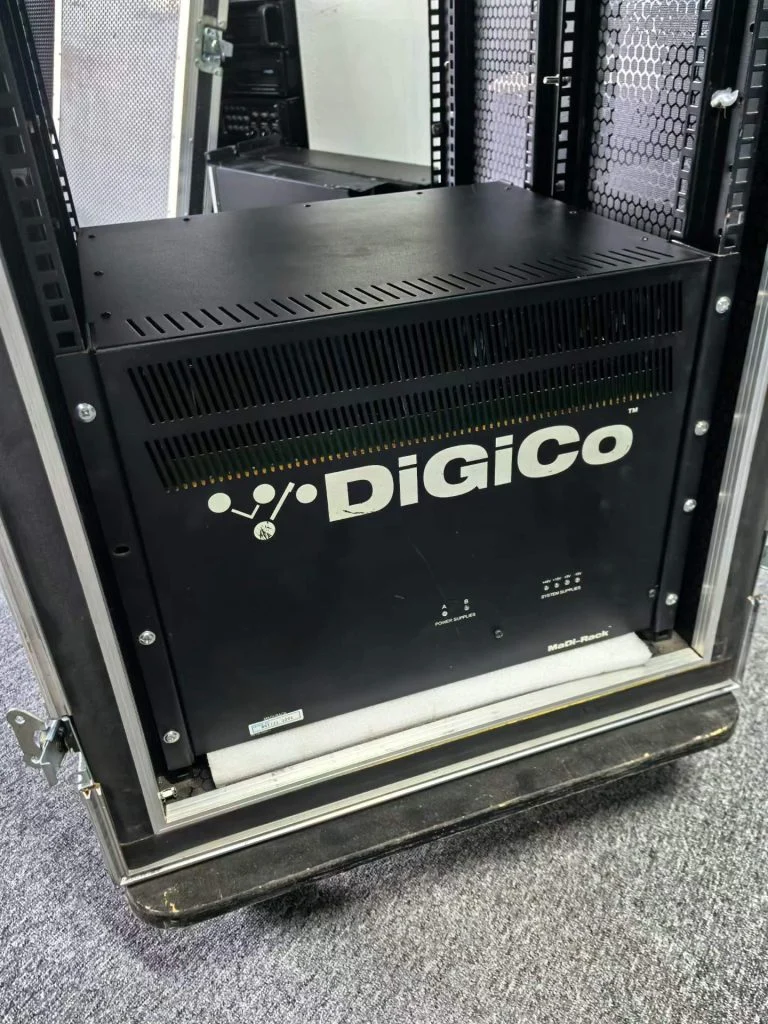
Used professional audio equipment for sale that keeps its value shares three traits: the brand still trades, replacement parts still circulate, and the gear does not depend on software. Powered speakers and quality analog desks lose roughly 5% a year. Budget digital controllers lose up to 70% in four years.
Most people buy used gear assuming depreciation is uniform. It is not. Two boxes bought at the same price in 2020 can be worth wildly different amounts today, and the difference is almost never about sound quality.
Why do some used speakers barely lose value?
Because a good speaker has no upgrade path. A 12-inch powered box from 2015 still does exactly what a 2026 model does: it makes sound accurately at a specified SPL. There is no new feature that makes it obsolete. That is the core reason cabinets and analog amplifiers hold value while digital desks do not.
A K-array KF12 bought used today will sound the same in five years. A digital controller bought today will fall out of driver support and lose most of its resale value. Same money, different fate.
| Gear type | Annual value loss | Why |
|---|---|---|
| Passive speakers | 3-5% | No electronics to fail |
| Powered speakers | 5-7% | Module can be replaced |
| Analog consoles | 4-6% | Stable demand from small venues |
| Digital consoles | 10-15% | Firmware and parts obsolescence |
| DJ controllers | 15-18% | Software support ends |
What makes a brand retain value?
Service network and part availability. Yamaha, JBL, and Shure hold value because a buyer knows they can get a replacement driver or capsule. A brand that vanished in 2018, even with good engineering, trades at a discount because the buyer is taking on orphan risk.
The Yamaha DM1000 is an interesting case. It is 25 years old and still sells for $2,200-2,800 because Yamaha parts and knowledge are everywhere. A newer desk from a defunct brand at the same original price might fetch $800.
Should you avoid digital gear entirely?
No, but buy digital gear to use, not to flip. If a digital desk saves you 20 minutes per show over five years, the resale loss is irrelevant. The mistake is buying digital gear as an investment, or buying a model whose manufacturer has already stopped firmware updates.
- Buy digital to use; expect it to be worth little in five years.
- Check the last firmware date. Two years or older is a warning.
- Confirm the control software runs on a current OS.
- Prefer models with a documented parts channel.
Which pieces are actually appreciating?
A few. Classic large-diaphragm condenser microphones from the 1970s and 80s, certain tube preamps, and high-end passive monitors have gone up 20-40% in five years as studio gear collectors entered the market. Those are exceptions driven by scarcity and reputation, not a general trend.
For a working venue, ignore appreciation plays. Buy gear that does its job, keeps a parts channel open, and can be sold in a week if you need cash. Browse the speakers category and compare condition notes across listings to see which items sit unsold the longest.
Key Takeaways
- Passive speakers lose 3-5% a year; DJ controllers lose 15-18%.
- Value retention tracks parts availability, not sound quality.
- A 25-year-old Yamaha DM1000 still sells for $2,200-2,800.
- Buy digital gear to use, never as an investment.
- Check the last firmware date before buying any digital desk.