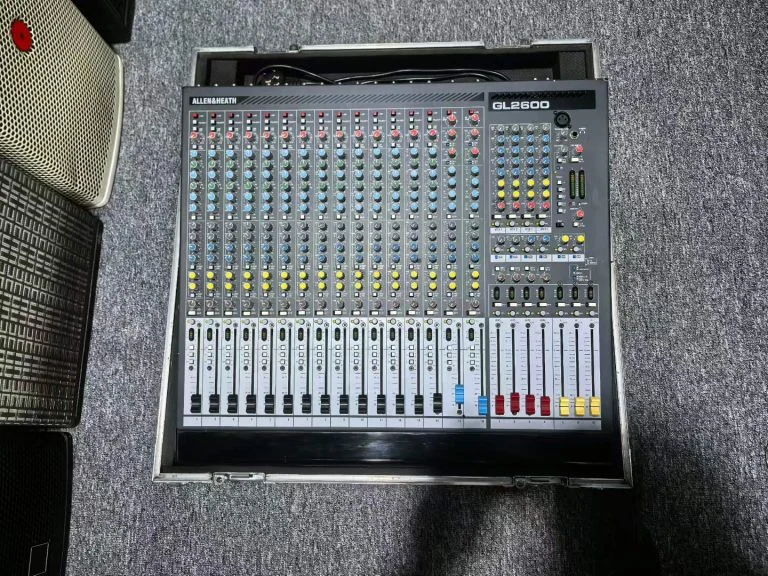
A used Allen & Heath GL2600 24-channel analog console sells for $900 to $1,500 in 2026. That is far below its $4,000-plus original price. It weighs around 38 kg, has no scene memory and no screen — and for a lot of rooms that is exactly what is wanted.
A&H built the GL2600 in the UK as part of the GL series, a workhorse line for clubs, churches and festivals. Every channel has a full 4-band EQ, six aux sends and a direct out. Nothing on the board needs a firmware update.
How much does a used GL2600 cost right now?
| Deal | Price (2026) | Reality |
|---|---|---|
| Untested, sold as-is | $500 – $800 | Expect to re-cap and fix a few channels |
| Working, all channels tested | $900 – $1,200 | The realistic buy zone |
| Serviced with case | $1,300 – $1,500 | Worth it if the case is original |
Shipping is the hidden cost. A 38 kg desk in a case goes as freight, not parcel — $250 to $450 by sea from China to Europe. Compare total landed cost, not the listing price.
Why would anyone still buy an analog console in 2026?
Two reasons that are hard to argue with. First, a monitor engineer standing at a GL2600 can reach every aux send without touching a screen. That speed is real, and it matters on a four-band festival stage. Second, when a channel dies, you look at the schematic and replace a $0.60 op-amp. No SMT rework, no board swap.
The cost: no scene recall means every show starts from zero. No processing per channel beyond EQ and a high-pass. No recording. If you rehearse on Tuesday and play Saturday, you will rebuild the mix by hand.
What goes wrong on a used GL2600?
Fader noise is the classic complaint. Scratchy faders on a 20-year-old desk usually mean dust, not death — a clean and lubricate fixes 80 percent of them. The other common faults are dry solder joints on the ribbon connectors between channel strips and a tired power supply.
Test every channel with a mic, move every fader slowly, and turn every pot from end to end while listening for crackle. Twenty minutes of testing saves a $300 repair bill.
Analog or digital at the same budget?
At $1,200 you can also buy a used digital desk like a Behringer X32 Producer or a smaller Yamaha. The Allen & Heath GL2600 listing shows current condition, and the Yamaha DM1000 is a useful digital counterpoint if you need scenes and recall for theatre work.
Pick analog for monitors and fixed installs where the same engineer works every night. Pick digital for touring theatre, corporate AV and anything that needs recall.
What does a full recap cost on a GL2600?
A full electrolytic recap on a 24-channel analog desk runs $400 to $700 in parts and labour at a workshop. Most desks do not need it. A targeted fix on the master section and the power supply, at $150 to $250, solves the usual noise complaints.
Only consider a full recap if you intend to keep the desk for ten years. For a rental or a temporary install, spot repairs are the sensible route.
Can one person move a GL2600?
Barely. At 38 kg with no handles on the right places, two people should carry it even for a short lift. In a case it is a four-person job or a ramp. If the desk lives in one room and never moves, none of this matters — which is the case for most church and club installs.
Check the case condition as carefully as the desk. A 38 kg console in a tired case with broken wheels is a permanent logistics problem.
What is the honest downside?
Weight, and no recall. Every show starts from zero, and a guest engineer who has not stood at an analog desk since 2015 will take an hour to settle in. For an install with one regular engineer, that is a fair trade. For a rental fleet, it is not worth the saving.
Key Takeaways
- Used GL2600: $900–$1,500 in 2026, 38 kg before the case.
- 24 channels, 4-band EQ, 6 aux — enough for most monitor mixes.
- Scratchy faders are usually dirt, not failure.
- No scenes, no recording, no per-channel dynamics.
- Sea freight adds $250–$450; compare landed cost.