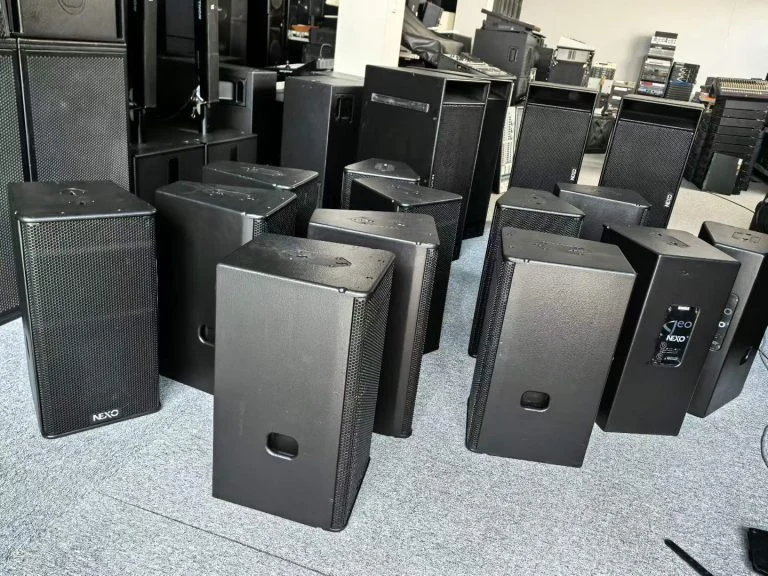
Worth it if you own NEXO processing and a small to mid-size venue to serve. A used GEO S1230 element at $600-1,400 against $2,500-4,000 new is a serious discount, and the box itself has very few failure points: one 12-inch woofer, one 3-inch compression driver, passive crossover or bi-amp terminals, and a rigging frame.
What are the specs that still matter?
The GEO S1230 is a 12-inch two-way element with a horizontal dispersion suited to 80-120 degree coverage per box depending on the horn fitted. Each element weighs around 30kg, and a 12-box array needs a frame rated for 400kg plus fly bar and motors. Vertical coverage is the whole point: 12 boxes give you roughly 12 degrees of vertical control that a point-source speaker simply cannot match.
Compare that with a stack of point-source 15-inch speakers: cheaper, but you cannot steer the coverage, and the rear of the room gets a very different sound from the front of the room.
Why is NEXO processing mandatory?
Because the element’s crossover and EQ were designed to run under NEXO’s own processor settings. Drive it with a generic amp preset and it will work, but the array will not behave predictably across the boxes. That means you either own a NEXO processor or you budget for one, and a used TDcontroller is $400-1,200 on its own.
This is the hidden cost that catches first-time buyers. The speakers look like a bargain until you realise you need processing, rigging frames and a compatible amp rack.
What does a full 12-box array cost?
- 12 used GEO S1230 elements: $7,200-16,800
- Rigging frame and fly bar: $1,500-3,500
- Processing and amp rack: $2,500-6,000
- Speaker cable and multipin looms: $800-1,500
- Flight cases for the array: $2,000-4,000
Total $14,000-32,000 for a working 12-box system that would cost $60,000-100,000 new. That is the real pitch for used line array, and it comes with the real caveat: check every element’s driver before you commit, because buying eight good elements and four with tired drivers ruins the deal.
We have a NEXO GEO S1230 line array with RS.15-C subwoofers listed with the subs included, which saves the more painful problem of matching a sub system to the array by guesswork.
How do you inspect line array elements?
- Check every element individually. Not just the first and last. The middle boxes in a flown array get the same hours as the ends.
- Inspect the rigging pins and frames. A bent pin or ovalised hole is a safety issue, and frames are expensive.
- Test the compression driver. A tired 3-inch diaphragm shows as reduced output above 8kHz relative to a known-good box.
- Look at the horn flares. Cracks or missing pieces change the coverage angle, and replacements are model-specific.
Who should not buy one?
Anyone without rigging knowledge, anyone serving rooms under 300 people, and anyone who cannot store and transport 400kg of flown equipment. A line array is not a better speaker; it is a specific tool for throwing sound evenly over distance, and it makes no sense in a small club or a wedding marquee.
Key Takeaways
- Used GEO S1230 elements cost $600-1,400 each versus $2,500-4,000 new.
- A full 12-box system lands at $14,000-32,000 against $60,000-100,000 new.
- NEXO processing is mandatory; add $400-1,200 for a used TDcontroller.
- Inspect every element, not just the ends; middle boxes age identically.
- Skip it for rooms under 300 people, where rigging effort is not repaid.